
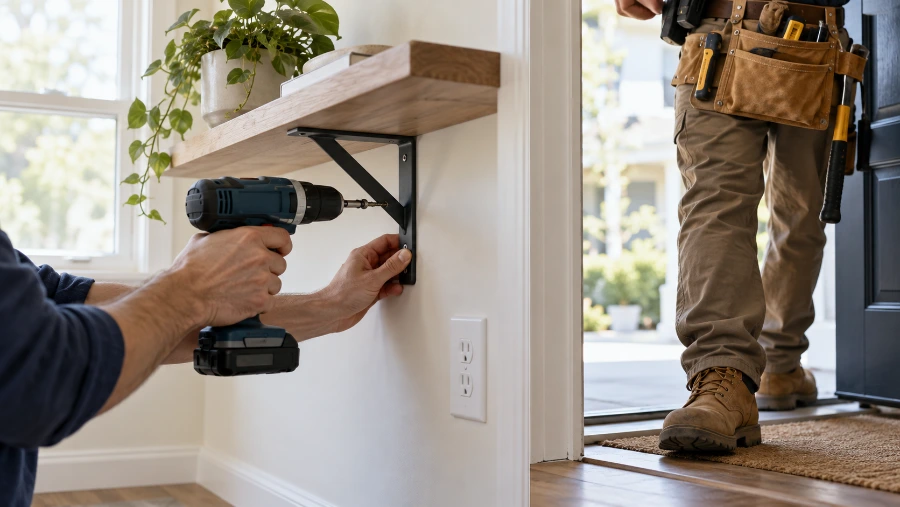
DIY or Hire a Pro? A Decision Guide for Common Home Projects
Do it yourself when a mistake is cheap, visible and reversible; hire a professional when a mistake could cause fire, flooding, a fall, structural damage, a failed inspection or a voided warranty. Painting, caulking and replacing a faucet fall in the first group; panel work, gas lines and roof structure fall in the second.
Five questions to ask before any project
- What is the worst realistic failure? A bad paint job is cosmetic. A bad wire or gas fitting can start a fire or poison someone.
- Can I undo it? If a mistake means tearing out finished work, the cost of failing goes up.
- Does it need a permit or inspection? Permits protect you at resale and with insurance. Ask your building department.
- Do I have the tools, time and a place to learn? Rental tools and a weekend are not the same as experience.
- Does it affect a warranty or insurance? Some manufacturers and insurers require licensed installation.
Typical calls by project
| Project | Usual call | Why |
|---|---|---|
| Interior painting, caulking, screens | DIY | Low risk, easy to redo |
| Replace a faucet or toilet fill valve | DIY | Shutoff valves limit the risk; test for leaks |
| Weatherstripping, door sweeps, window sealing | DIY | Low risk |
| Swap a light fixture or outlet | DIY with care, or pro | Power off at the breaker and confirm with a tester; some areas require a licensed electrician |
| Ceiling fan install | DIY with care, or pro | Needs a fan-rated box and secure support |
| Tile, flooring | DIY if patient, or pro | Prep and layout decide the result |
| Drain clogs | DIY first, pro if repeated | Repeated backups can mean a main-line problem |
| New circuits, panel, service upgrade | Licensed electrician | Fire and shock risk; permit and inspection |
| Gas lines and gas appliances | Licensed pro | Leak and carbon monoxide risk |
| Main sewer line, septic | Licensed pro | Specialized equipment, health risk |
| Steep roofing, structural changes | Licensed pro | Fall and structural risk |
| Refrigerant work on HVAC | Certified technician | Federal rules require certification to handle refrigerants |
| Asbestos or lead paint disturbance | Certified pro | Health risk and legal rules |
Local rules differ. Some states allow homeowners to do their own electrical or plumbing under a permit; others do not. Check with your building department.
How to tell what a job really costs
Price both options honestly. For DIY, add tools, materials, a 10 to 20 percent allowance for mistakes and extra trips (a common planning rule), and your time. For a pro, get at least three written quotes and compare scope, materials, permits and warranty, not only the total.
Signs you should stop and call someone
- You cannot identify what is behind the wall, ceiling or floor you are about to open.
- The job needs you to work on a live circuit or a gas line.
- You are working at a height you are not comfortable with.
- The problem keeps coming back.
Mistakes homeowners report most
From homeowner threads on Reddit and Quora: underestimating prep time, skipping the permit, buying cheap tools that fail mid-job, and starting a project that leaves the house without water or a working bathroom. Plan around those.
Written by Nolan Wexford, editor of VistaNestDaily. Last updated: October 23, 2026.
General information only. Codes, prices and conditions vary by location. Work involving electricity, gas, structure or lead paint should be done or checked by a licensed professional.